Collaboration by Design: Client-Agency Collaboration at its Best
Our ongoing collaboration with the Center for the Study of World Religions at Harvard Divinity School is a visionary publishing project with the highest aesthetic and scholarly standards. It has also become a masterclass in what exceptional client–agency collaboration looks like.
Together, we’ve built a partnership defined by shared vision, creativity, and remarkably smooth orchestration. How can you achieve this level of collaboration on your own high-stakes projects? Here we’ll explore some of the lessons that emerged from one of our most challenging and rewarding creative undertakings.
Inspired design, extraordinary requirements
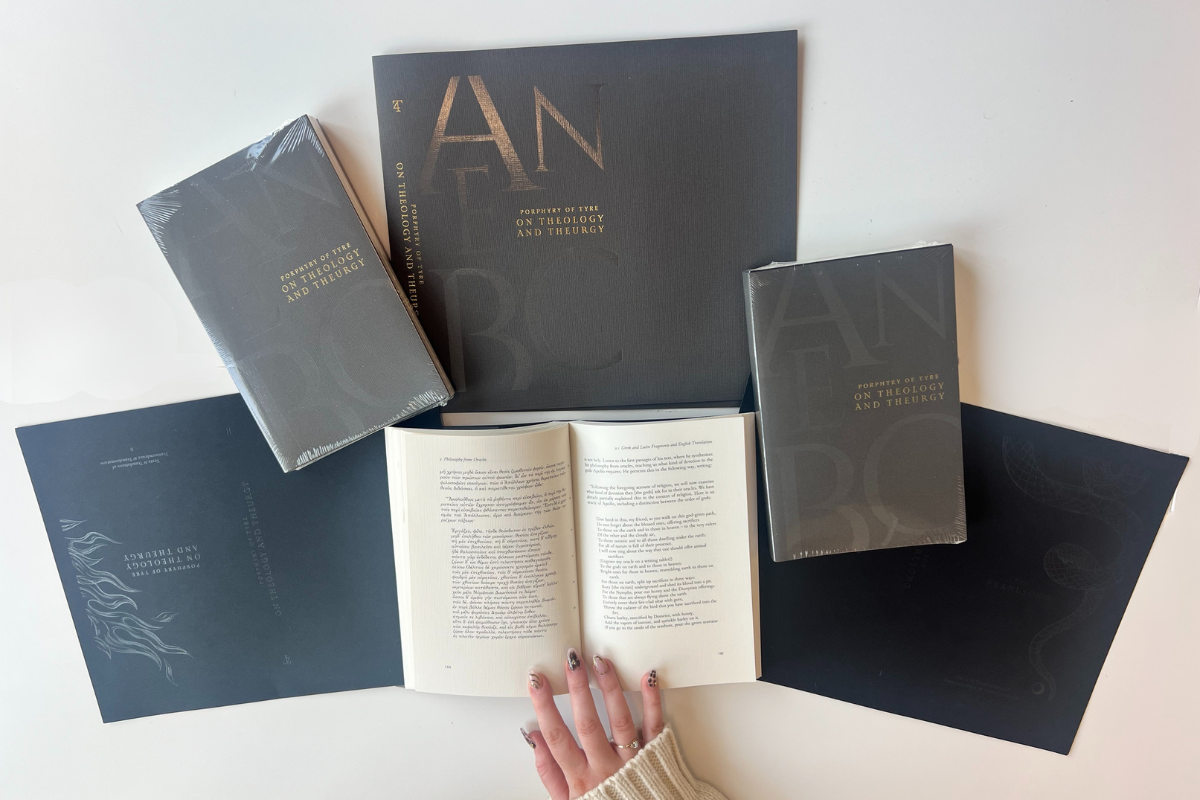
The Center’s mission to study the world’s religions in their classical and historical forms has led to a new publication series featuring ancient mystical texts. Titled Texts and Translations of Transcendence and Transformation (4T), the books span geography from Morocco to China, tracing routes of spiritual tradition across the Silk Road.
Designing the series was an exercise in balancing elegance with usability, and dozens of micro-decisions shaped the final product.
- Each volume’s jacket and cover feature a unique design for its title, artwork, and color palette.
- The books lie completely flat for study, and present original source texts and English translations on facing pages.
- Interpretive aids are included, and margin space is suitable for writing and erasing.
- A Smyth-sewn binding paired with 70# Sundance Linen Natural Text paper stock delivers the tactile quality, durability, and writing surface required.
Best practices for high-level collaboration
Using the first book in the series — The Pearlsong — as a pilot, we established a model that will guide all future editions. Here’s what made the collaboration work; you can use these lessons as a guide for fostering your own successful partnerships.
1. Establish a shared mission early
Before anyone opened InDesign or considered paper stock, we aligned on vision, purpose, and aesthetic expectations. Shared mission became the North Star; every decision traced back to it.
“We conducted extensive research and studied printed books the client admired to understand their aesthetic vision,” says Martha Lindman, associate creative director and lead designer of the series. “I also read the texts to be sure I understood their meaning and could capture their essence in the design. All the design work complemented the paper and printing process, accentuating the uniqueness of the project.”
2. Clarify roles and project governance
This was a true relay. Design, production, printing, review, and assembly all required precise hand-offs between client and agency partners. Each team member knew when it was their leg of the race to run. Clear project governance prevents drift, delays, and duplicated work and ensures accountability.
“Our clients at Harvard are extremely passionate about their work. Our team matched that energy from the very first meeting. Each iteration, review, and budget discussion happened with our team, Signature Printing, and Harvard working together,” says Stephanie Nademlynsky, senior account executive. “All facets of the team were involved in finalizing our design and strategy and keeping us within our production budget.”
3. Build trust through mutual respect
It is extremely difficult for a team to produce elegant, high-quality work under tension or turf battles. Throughout this process, open communication and trust allowed for candid conversations about aesthetics, feasibility, and trade-offs. It also made room for expertise to shine where it mattered.
4. Give clear, constructive feedback
For each book, the team produced two cover and dust jacket design options, allowing us to explore various concepts without overwhelming decision-makers. Timely, focused feedback from all parties helped keep the process moving and productive.
“The client’s feedback was essential in helping us determine the ideal combination of materials,” says Chuck Zeoli, RDW production manager. “They trusted us to explore an incredible range of materials and processes, from paper stocks, inks, foils, and embossing to special binding materials.”
5. Engage the right partners and keep them involved
A project of this complexity requires specialists with deep technical knowledge. We relied on Signature Printing, one of our long-standing partners, to research paper stocks, and to test embossing, debossing, foil stamping, and binding techniques that would honor both the artwork and the texts’ cultural significance. Having key partners at the table from the onset of the project was essential in ensuring material decisions were truly representative of the client team’s vision.
6. Navigate obstacles with resilience
Every high-quality project encounters obstacles. What matters is how the team responds. We dealt with paper availability, budget constraints, and material trade-offs. We evaluated dozens of options, always balancing cost, usability, and aesthetics while remaining flexible.
7. Stick to the brief
With many stakeholders, concept creep is a real threat. Our shared mission and continual, open communication kept the project grounded, protected the clarity of the original vision, and ensured every voice was heard. The result: creative discipline rather than a diluted consensus.
Conclusion: Client-Agency collaboration as craft
Our work on Harvard Divinity School’s 4T publishing series demonstrates what’s possible when client and agency teams align deeply and work well together. By balancing discipline with imagination, we worked together to turn a complex scholarly publishing initiative into a work of art.